

Every meal you cook leaves a climate signature. In India, where hundreds of millions of households are moving up the energy ladder from firewood and dung to LPG cylinders, and increasingly to electric appliance the choice of cooking fuel is one of the most direct climate decisions a family makes.
But "which fuel is cleanest?" is trickier than it sounds. Biomass is renewable, yet it can be dirtier than fossil gas. Electricity is clean at the stove, yet its footprint depends entirely on the power grid behind it. This guide compares the three main cooking fuels biomass, LPG, and electric on lifecycle carbon emissions, efficiency, and health, using data from the WHO, India's Central Electricity Authority (CEA), and peer-reviewed studies.
What is the carbon footprint of biomass cooking?

Biomass cooking fuels include firewood, charcoal, crop residue, and dung cakes. They are often called "carbon neutral" because the CO₂ released when wood burns was absorbed by the tree as it grew.
But this is misleading for two reasons:
- Carbon neutrality only holds if biomass is sustainably harvested and regrown. Where cooking drives deforestation, it is not carbon neutral.
- Open biomass stoves burn incompletely, releasing methane and black carbon (soot). Residential solid-fuel burning accounts for up to 58% of global black carbon emissions, a short-lived but extremely potent climate warmer.
When black carbon and methane are counted, "carbon-neutral" firewood can have a climate impact similar to or greater than LPG.
Health impact: Biomass is the most harmful fuel for indoor air. Switching households from biomass to LPG sharply reduces indoor PM2.5, PM10, and PM1, improving respiratory health within months.
What is the carbon footprint of LPG cooking?

LPG (liquefied petroleum gas) is a fossil fuel, so all its CO₂ counts against the climate. However, it burns cleanly and efficiently, which is why the World Health Organization designates LPG a "clean" cooking fuel.
Key LPG carbon facts:
- LPG's CO₂ emissions are roughly one-seventh those of charcoal and one-fourth those of wood.
- Switching from wood to LPG can cut net atmospheric CO₂ by around 60% in tropical regions.
- LPG emits approximately 60 grams of CO₂-equivalent per megajoule of delivered cooking energy.
- LPG avoids the deforestation risk that biomass carries.
LPG is the reliable "clean default" for cooking today, available across urban and increasingly rural India through programs like Ujjwala. Its limitation: as a fossil fuel, its footprint can never reach zero.
What is the carbon footprint of electric cooking?

Electric cooking produces zero emissions at the point of use. Its real footprint lives upstream, at the power plant, and is determined by the grid emission factor — how much CO₂ is released to generate one unit of electricity.
India's grid emission factor (CEA Version 21.0):
- FY 2024-25: 0.710 tonnes of CO₂ per MWh (about 710 grams CO₂ per kWh).
- This is down from 0.727 the previous year and 0.774 a decade ago.
- In FY 2025-26, about 29% of India's electricity came from non-fossil sources.
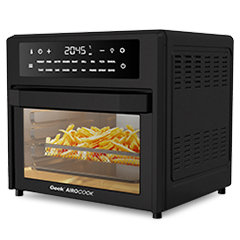
Why efficiency changes the picture: electric cooking transfers roughly 85–90% of its energy into the pot, versus around 40% for a gas flame. So the electricity actually needed per meal is far lower than the raw grid factor implies.
The key takeaway: On a coal-heavy grid, electric cooking is competitive with LPG thanks to efficiency. On a clean grid (high renewables or nuclear), electric cooking beats LPG comfortably. And unlike LPG, electric cooking gets cleaner every year automatically as the grid decarbonizes.

Which cooking fuel has the lowest carbon footprint?
Putting the evidence together, here is how the three fuels rank from cleanest to dirtiest in a modern, decarbonizing context:
- Electric — zero emissions at the stove; total footprint depends on the grid and drops every year as renewables grow.
- LPG — a clean-burning fossil fuel; about 1/4 the CO₂ of wood and 1/7 of charcoal.
- Biomass — renewable but high in black carbon, methane, and particulate matter; often the highest real climate and health impact.
There is no single silver-bullet fuel. The best choice depends on your local electricity grid, fuel access, and whether biomass is sustainably sourced.
Which cooking fuel should you choose?
If you currently use biomass: Almost any move up the energy ladder is a win for your health first, and usually for the climate once black carbon is counted. Prioritize switching.
If you're choosing between LPG and electric in India today: It's close and grid-dependent. LPG is a dependable, genuinely clean-burning fuel available everywhere. electric cooking is more efficient and is the better long-term bet, because its footprint shrinks automatically as India's grid decarbonizes.
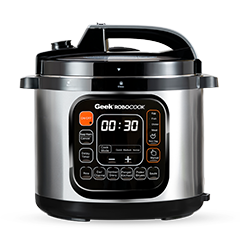
The forward-looking answer is electric. LPG is a good clean fuel but is locked to a fossil source. Electricity is the only cooking energy that can reach near-zero carbon and pairing an electric pressure cooker with rooftop solar essentially achieves that today.
The bottom line
Biomass is renewable but dirty; LPG is fossil but clean and reliable; electric is zero emission at the stove and steadily greening upstream. For most Indian households, the smart trajectory is clear: move off solid biomass as fast as possible, use LPG as a clean bridge, and shift to efficient electric cooking as the grid and your own rooftop gets cleaner.