

The science behind India's most used appliance and where the health claims are oversold
Every Indian kitchen has a pressure cooker. Most of us use it because it's fast. What we don't usually think about is what's happening to the nutrients inside and why the fastest method also happens to be one of the gentlest on your food.
The short answer: pressure cooking preserves more nutrients than boiling because it cooks food faster and uses far less water. Nutrients are lost through prolonged heat exposure and by dissolving into cooking water that gets thrown away. Pressure cooking reduces both. This guide explains the mechanism, what the research shows, where the health claims are genuinely oversold, and how to pressure-cook correctly.
How Does Cooking Destroy Nutrients?
Nutrients are lost in exactly two ways: heat destruction and leaching into water. Understanding both explains why boiling performs so poorly.
Heat destruction. Certain vitamins are chemically fragile. Vitamin C, folate, thiamine (B1) and several B-complex vitamins break down when held at high temperatures for extended periods. The key phrase is extended periods it's total heat exposure over time that matters, not just the peak temperature.
Leaching into water. Water-soluble nutrients vitamin C, B vitamins, potassium, magnesium dissolve out of food and into the cooking liquid. Boil spinach in a litre of water and pour that water down the drain, and a meaningful share of its nutrition goes with it.
Why boiling loses: it loses on both counts. Boiling takes longer, and it uses far more water water that usually gets discarded.
What Does Pressure Cooking Do Differently?
Inside a sealed pressure cooker, steam can't escape. Pressure builds, and the boiling point of water rises from 100°C to roughly 120°C. Higher temperature sounds worse for delicate vitamins but this is where the arithmetic works in your favour.
Cooking time drops dramatically, often by 60–70%. Rajma that takes 90 minutes in an open pot is done in 20. Dal that takes 45 minutes takes 12.
The key principle: total nutrient loss depends on temperature multiplied by time. Pressure cooking raises one factor slightly and slashes the other enormously. The net result is less destruction, not more.
Then there's the water. Pressure cooking needs a fraction of the liquid usually just enough to generate steam. Less water means less dissolving. And in a one-pot dish like khichdi, sambar or pulao, that cooking liquid is the dish. Nothing gets drained. Whatever leached out of the vegetables is still on your plate.
What Does the Research Show?
Studies comparing cooking methods have consistently found pressure cooking retains more fragile nutrients than prolonged boiling. Vitamin C retention in pressure-cooked vegetables runs meaningfully higher than in boiled ones, largely because of shorter exposure and less leaching. The same pattern holds for B-vitamins and for antioxidant compounds in legumes and vegetables.
The antinutrient benefit most people miss
Pressure cooking is particularly effective at breaking down antinutrients. Phytic acid in legumes and whole grains binds to iron, zinc and calcium, blocking absorption. Lectins in kidney beans and other pulses cause digestive distress. Both are reduced substantially by pressure cooking more effectively than by ordinary boiling.
This matters enormously in Indian diets. If you eat a lot of dal, rajma, chana and whole grains, pressure cooking isn't just preserving the nutrients that are there. It's making more of them actually absorbable.
A real safety benefit: pressure cooking is one of the few methods that reliably destroys lectins in kidney beans. Undercooked rajma genuinely causes food poisoning so this isn't a marketing point, it's a safety one.
Pressure Cooking vs Steaming vs Boiling: Which Is Best?
Steaming wins for quick-cooking green vegetables. Pressure cooking wins for legumes, whole grains, root vegetables, meat and one-pot dishes. Boiling with discarded water loses in nearly every category.
Steaming is often held up as the gold standard, and for delicate vegetables it's excellent food never touches the water, so leaching is minimal. But steaming is slow for dense foods. Steaming rajma or chana isn't practical, and for anything requiring extended cooking, that long exposure starts eating into heat-sensitive vitamins

The one rule that covers everything: if you must boil, keep the water. Use it in your dal, gravy, soup or rice, and most of boiling's disadvantage disappears. The problem was never the boiling itself it was pouring the nutrition down the sink.
Where the Health Claims Are Oversold
Pressure cooking has real advantages, but it isn't magic. Here's the honest picture the parts most brands leave out.
● Resistant starch. Pressure-cooked rice and potatoes gelatinise starch very thoroughly, which can push glycemic response up compared to gentler cooking. Cooling cooked rice or potatoes overnight partly reverses this. For diabetics, this matters more than the vitamin retention story.
● Overcooking is the default failure mode. Most home cooks set five whistles out of habit. Vegetables turn to mush and mushy food digests faster and spikes blood sugar higher. The nutrient advantage assumes correct timing, which most people don't observe.
● Vitamin C. Better than boiling, worse than steaming or eating raw. Pressure cooking doesn't make anything a good vitamin C source.
● Texture and satiety. Very soft food is eaten faster and with less chewing, which is weakly linked to eating more. Minor, but real.
The honest bottom line: the "healthy" halo transfers to the dish, not the method. A pressure cooked biryani with six tablespoons of ghee isn't healthy. A pressure cooker cooking white rice three times a day isn't healthy. The method is neutral about what you put in it.
How to Pressure Cook for Maximum Nutrition
A few things separate good pressure cooking from careless pressure cooking:
● Use the minimum water needed. More water means more leaching and more time to come to pressure. Follow the recipe rather than habit.
● Don't overcook. The advantage comes from shorter times. Setting rice for 20 minutes when it needs 6 throws the entire benefit away.
● Never drain the liquid. If there's excess water left, reduce it into the dish or use it as stock. That liquid holds the minerals and vitamins that came out of your food.
● Add delicate items later. Leafy greens, tomatoes and quick-cooking vegetables don't need the full cycle. Add them at the end, or use a short pressure release.
● Release pressure appropriately. Quick release stops cooking immediately, protecting texture and nutrients in vegetables. Natural release continues cooking gently better for legumes and meat.
Safety & Material Questions People Actually Ask
Are aluminium pressure cookers safe?
Aluminium leaches, more so with acidic foods like tamarind, tomato and lemon. The evidence for harm at dietary levels is weak, and health agencies don't consider normal use dangerous but stainless steel avoids the question entirely and is the sensible default.
Are non-stick inner pots safe under pressure?
Modern PTFE is stable at pressure-cooking temperatures. The risk is a scratched or degraded coating, not the coating itself. Stainless inner pots are the conservative choice.
Electric or stovetop pressure cooker which is better?
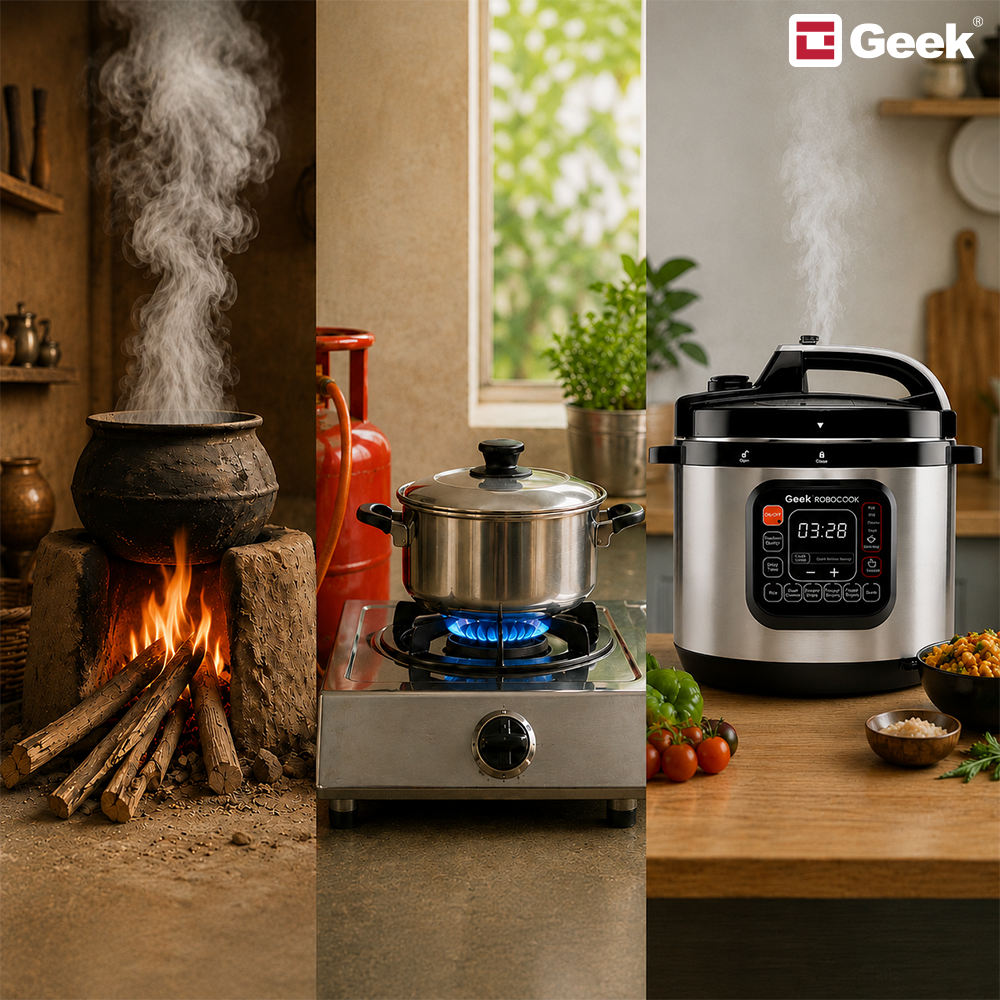
An electric pressure cooker holds temperature and pressure more precisely, which reduces overcooking. Since overcooking is the single biggest way people lose the nutritional advantage, that precision is a genuine health point in favour of electric — no guesswork about whistle counts or flame adjustments. Consistent conditions mean consistent results, and repeatability is what turns a good cooking method into a daily habit.
The Convenience Is the Point
There's a version of healthy eating that requires enormous effort and most people abandon it within a month.
The genuinely useful thing about pressure cooking is that the nutritional advantage and the convenience advantage are the same advantage. You're not choosing between fast and healthy. The mechanism that makes it fast sealed, high-pressure, short-duration, lowwater cooking is precisely the mechanism that keeps nutrients in your food.
Geek Technology builds electric pressure cookers designed for real Indian kitchens holding pressure and temperature precisely, so the timing that protects your food's nutrition happens automatically, every time.