
Moving to electric cooking and prep appliances isn't a luxury anymore in today's world it's close to a must. Gas connections are getting costlier and harder to refill in cities, apartments increasingly come without piped gas, and modern electric appliances simply do more in less time: they crisp, grind, boil, pressure-cook, and reheat while you get on with your day.
But here's the real problem. Walk into any store or open any shopping app and you'll find eight near-identical machines staring back at you, each promising to be the best. Most of us end up buying on price alone, or on a friend's recommendation and six months later that shiny appliance is gathering dust in a cupboard.
So how do you choose the right one for you and your home? That's exactly what this guide answers. Instead of pushing one product, it walks you through the seven checks that apply to any appliance — a rice cooker, mixer grinder, air fryer, induction cooktop, kettle, or anything you plug in.
Why it matters: An appliance is a 5–10 year relationship. The wrong pick wastes money, quietly inflates your electricity bill, and eats up scarce counter space. The right one saves time, effort, and money every single day without you noticing.
1. Family Size & Capacity

The first question isn't "which brand?" it's "how many people am I cooking for?" Capacity is where most people go wrong, usually by buying too big "for the future."
The catch with capacity: stated size is not usable size. Almost every appliance can only be filled part-way, because food needs room to move, boil, or circulate. Always mentally knock off about a third from the number printed on the box the "usable" capacity is smaller than the "stated" capacity.
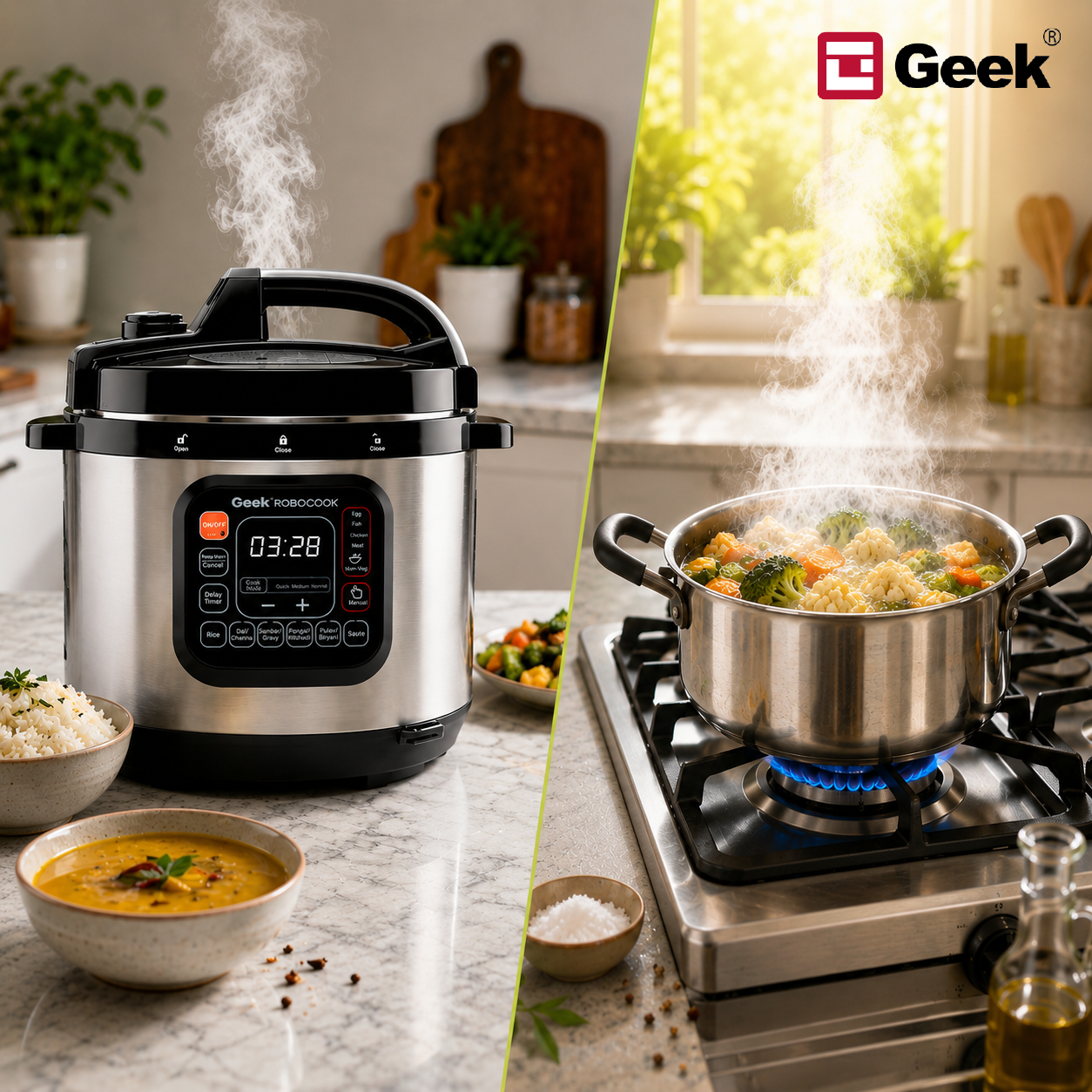
How an electric pressure cooker is measured an important quirk
The electric pressure cooker is a good example of this trap. Its capacity is measured by the total volume of the inner pot but you can never fill it to the brim. For safety, a pressure cooker should only be filled about two-thirds full, and no more than half full for foods that foam or expand, like dal, rice, or beans. The steam and pressure need that empty space above the food to build up safely. The number on the box is the pot size, not the meal size.
The same applies everywhere: an air fryer basket stops crisping when overloaded, and a mixer jar won't blend past its line. Match usable capacity to your household, not the headline number.
Rule of thumb: Buy for your everyday meals, not the once a year festival crowd. You can always cook a second batch but you can't un buy an oversized machine that hogs your counter and draws more power than you need.
2. Available Space: Measure Before You Buy

Measure your kitchen before you fall in love with a machine. Counter space is the most overlooked constraint an appliance you must lift out of a cupboard gets used about half as often as one that lives on the counter.
Measure the real footprint, not just the base. Air fryers, cookers and kettles vent hot air and need 4–6 inches of clearance behind and above them. A machine that technically "fits" but sits jammed under a cabinet can scorch the wood or trip its own safety cut-off.
Are many in one appliances worth it?
Yes if counter space or budget is tight, a multi-function appliance is usually the smarter buy. One machine replacing three means less clutter and lower combined cost: a good multi-cooker usually costs less than three single-purpose gadgets. A modern electric pressure cooker can pressure-cook, slow-cook, sauté, steam and make yogurt in one footprint.
One honest caution: a jack-of-all-trades rarely beats a specialist. If you make one dish daily, a dedicated appliance may serve you better. Buy multi-function for variety, single-function for daily heavy use.
3. Budget: Look Beyond the Price Tag
Set a range, not a single number and separate the two costs every appliance carries: the purchase price you pay once at the counter, and the running cost you pay every month in electricity, plus replacement parts like gaskets, jars and filters.
A cheaper machine can quietly be the expensive one. A budget induction cooktop drawing 2000W can cost more over three years than a pricier, efficient model you pay that difference on every bill. Think total cost of ownership, not just the sticker.
Smart budgeting tip: Add a 20% buffer for the accessories nobody mentions a voltage stabiliser, extra jars, a spare gasket. Protecting a ₹15,000 appliance with a ₹1,500 stabiliser is money well spent.
4. Energy Efficiency: Wattage & BEE Star Ratings

Energy efficiency decides your monthly bill long after the purchase excitement fades. Two things to check — and knowing which applies to your appliance saves real money.
BEE star rating: a government label showing how much electricity an appliance uses, on a scale of 1 to 5 stars. More stars = lower consumption = smaller bills. Issued by India's Bureau of Energy Efficiency, it's genuinely useful for big power-hungry machines like refrigerators, ACs and washing machines.
Here's what most buyers don't realise: small kitchen appliances rarely carry a BEE Rating at all. Mixer grinders, air fryers, kettles, induction cooktops and rice cookers usually aren't covered by the
programme, so you won't find stars on the box. Don't let a salesperson use the absence of a star rating to push a "premium" model — the label was never expected here.
How do you check efficiency without a star rating?
Check the wattage on the box or rating plate. Of two machines doing the same job, the lower-wattage one costs less to run. A mixer draws a few hundred watts; a heating appliance pressure cooker, kettle or induction cooktop pulls over a thousand, because generating heat is what consumes electricity. So compare wattage only between machines of the same type.
Quick electricity maths: A 1500W appliance running one hour a day ≈ 45 units a month ≈ about ₹360 (at ₹8/unit). The formula — wattage × hours × days ÷ 1000 = units lets you predict any appliance's monthly cost before you buy
5. Features: Useful Upgrades vs Gimmicks
Some features genuinely make life easier. Others just look impressive on the box. A simple test: if you'd use it at least once a week, it's an upgrade; if not, it's a gimmick.
Which appliance features are worth paying for?
● Smart presets one touch programmes for common dishes. If they match what you actually cook, they're a real time-saver.
● Auto shut-off & dry-boil protection switches off before it overheats or runs dry, protecting your kitchen and the machine.
● Overload protection on mixers and grinders, saves the motor from burning out under heavy loads.
● Dishwasher-safe or detachable parts the most underrated feature. A machine that's a pain to clean quietly stops getting used.
● Multiple heat or speed settings, and a timer real control, from gentle simmering to fast grinding and delayed cooking.
Which features are just gimmicks?
● Presets you'll never use twenty programmes when you'll touch three is marketing, not capability.
● "Premium" cosmetic finishes fancy colours and chrome trim add price, not performance.
● Accessories you won't reach for, and oversized capacity bundled moulds that live in a drawer are clutter you paid for, and bigger isn't better: it costs more, takes more space and uses more power.
6. Trust, Warranty & Service: How to Check a Brand

You don't have to stick to only the big, famous brands. Plenty of newer, smaller D2C (direct-to-consumer) brands sell genuinely good products at fair prices. What matters isn't the size of the brand it's whether they stand behind what they sell.
● Read the warranty terms closely the product warranty often differs from the motor warranty. A "2-year warranty" might cover the body but give the motor only one year.
● Check the brand on social media one that posts regularly and replies to complaints takes service seriously. Silence is a warning sign.
● Read reviews for that exact product recent ones (last six months), including the 2- and 3-star reviews, which reveal the real weaknesses.
● Check it on Amazon and Flipkart too even if buying from the brand's own site. Reviews there are more numerous and honest, revealing common complaints and how it performs in real Indian kitchens.
● Confirm spare parts and the return policy an appliance you can't get jars, gaskets or filters for becomes disposable the day one part wears out, and a vague return window tells you how much the brand trusts its own product.
7.Quick Buying Checklist
Before you tap "Buy Now", run through this list. Ten minutes here saves years of regret.
● Sized the appliance to how many people you cook for on a normal day — and remembered stated size isn't usable size.
● Measured your counter space, leaving clearance for hot air.
● Considered a many-in-one appliance if space or budget is tight.
● Thought about the monthly running cost, not just the price tag.
● Checked BEE stars for big appliances, or compared wattage for small ones.
● Listed the 3–4 features you'll truly use every week.
● Confirmed warranty details, service reach and spare-parts availability.
● Read recent, honest reviews for that exact product on Amazon and Flipkart, and checked the return policy.
Conclusion
The right appliance isn't the costliest one or the one with the most buttons it's the one that fits your kitchen, your family and the way you actually cook.
Start with a simple question: how do I really cook, and for how many people? Match the size to that, measure your space honestly, think about the electricity bill as well as the sticker price, pay for the few features you'll genuinely use, and make sure someone can repair it when it needs fixing.
And don't feel you must chase only the big names. A smaller, newer brand can serve you beautifully as long as you do a little homework on their reviews, social media and service. A ten minute check on Amazon or Flipkart often tells you everything you need to know.
Ten minutes with this checklist saves years of regret.